


Gas grills are just beginning to gain popularity in Lithuania, while in the world they account for the largest share of all barbecues sold. We still have a lot of opinions, but not fact-based beliefs, why gas grill food is inferior to charcoal (and especially kamado) grills.
This time, we will not expand on this topic, which causes a lot of discussion - we will leave it for our other posts. However, even for a moment, I would like to remind you of the advantages of gas grills, such as the ability to quickly and significantly increase or decrease the temperature and its extremely simple control, even burning, large grill area, low fuel consumption, the possibility of legal grilling on balconies and terraces, safety, etc.

If you have already decided that a gas barbecue best suits your needs and situation, we invite you to read the information about the choice of fuel and gas cylinder.
Gas composition
Natural gas is extracted from deep in the earth. They consist of mixtures of gases with different chemical composition and different physical properties. They usually contain various proportions of methane (base), ethane, propane, butane, carbon dioxide and other gases. Gas is used in industry and in our homes, where the stoves are connected to a centralized city or town gas pipeline, mainly consisting of methane.
Since methane releases relatively little heat, gas grill manufacturers around the world suggest using other gases - propane, butane, or a mixture of these 2 gases. Burning the same amount of propane/butane secretes 2.5 times more heat compared to methane-based gas.
So if your grill lacks heat or you cannot cook a tender steak at home with a gas stove (it needs a high temperature), the answer lies precisely in the type of gas. You just need to change the gas used from methane to propane/butane gas.
Propane or Butane?
Obviously, due to the heat generated, the choice narrowed down to propane and butane gas or their mixture. Butane gas is slightly cheaper than propane, and you can find canisters filled with this gas in many more places of sale. But cheaper is not always better.
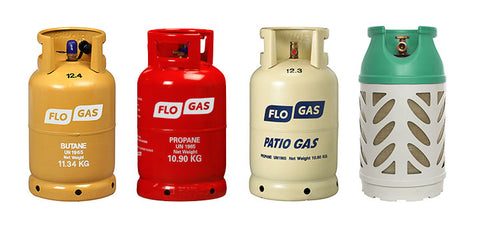
In the summer you can choose any type of gas, while as the weather cools down, keep in mind that butane gas turns into a liquid already at a slightly minus temperature (-2C), and propane - only after reaching -42C. Once the gas turns into a liquid, you simply cannot get combustion and heat anymore. So at lower temperatures and choose only propane gas in the winter.
If you have a mixture of propane and butane in your cylinder, you simply won't have that much pressure in the winter and won't fully burn the gas in the cylinder. So be careful - although it will seem that there is still gas in the cylinder, maybe it is just butane in liquid form.
Although you sometimes hear opinions that the taste of food differs when cooking with different gases, we leave that for you to decide.
Gas cylinders produced abroad often have different colors: cylinders filled with butane are blue, while cylinders filled with propane are red.
What balloon size to choose?
First of all, this is determined by your grill itself: if its cart has a safe place underneath (in the cabinet), it would be quite silly not to use it. All the more so because the aesthetic image is still important to the frequent griller. And balloons are usually not the most decorative part of the yard or terrace. So, if you are going to store the balloon in a cabinet, check the grill manufacturer's instructions or the information in the grill cabinet about the capacity/height of the balloon you can place. If such information is not provided, you will have to measure yourself. Choose the maximum size you can fit.
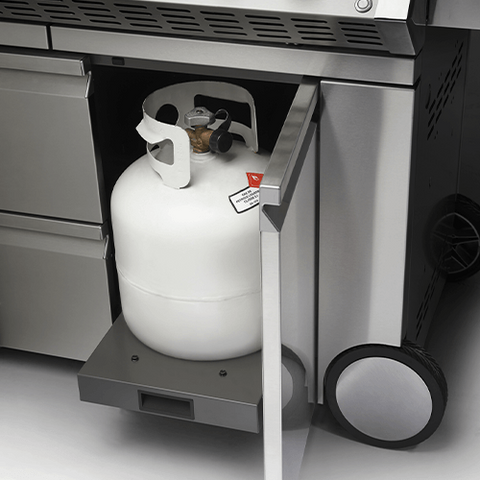
In any case, regardless of whether you keep the balloon in a cupboard or near the grill in the open, we recommend having 2 cylinders: let one be used and connected to the grill, while the second one is a replacement. After all, you don't want to run out of gas in the middle of the party itself - which seems to happen on purpose at the most inopportune moment...
What is the balloon made of?
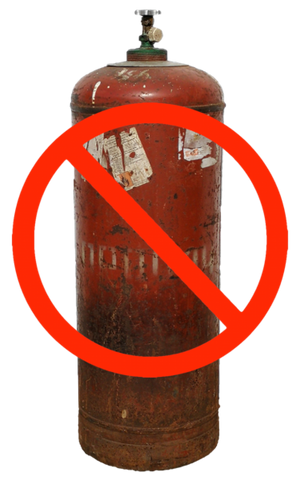
In the next 3 years, the Lithuanian government, based on EU laws, plans to ban the operation of old balloons still manufactured in the Soviet Union. The argument is their safety. Such cylinders will simply not be filled at a gas station. So if you are planning to buy a gas cylinder, think about whether it is worth saving here.
The most commonly used gas cylinders are – metallic. They are extremely heavy, so they cause a lot of inconvenience when changing their location or transporting them for replenishment. One of our recommended solutions - composite balloons.
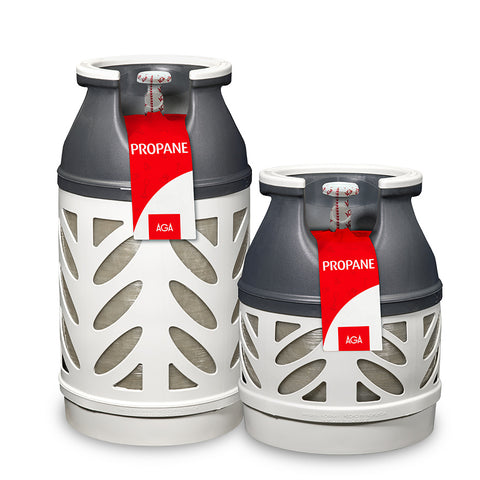
Composite gas cylinders (made by "Linde")
Jthere are a lot of advantages:
- You can track the amount of remaining gas so that it does not run out unexpectedly: there is a special transparent place on the side of the cylinder.
- Ultra light - 2 times lighter than steel cylinders of the same size.
- They are particularly durable: the composite material withstands sunlight, UV radiation, temperature changes, chemicals and solvents well.
- The balloon does not rust or scratch, it is easy to keep the balloon clean and recycle it.
- A balloon made of composite material does not explode when exposed to fire. As the substance dissolves, the balloon deflates as the gas escapes into the environment.
The composite cylinder is adapted for use in almost all ways of using propane at home, in summer houses, in barbecues, in campers, on boats. It is convenient to use as it is easy to grip when lifting. The use of the cylinder is further facilitated by the cylinder pressure valve, to which a regulator can be easily connected ("Clip on" system). You will no longer need strong hands or a special tool. This "Clip on" system is very happy for women who like to grill.
You can buy and fill these cylinders at the gas stations of the international company "Linde" (formerly "AGA"), and for more information see here
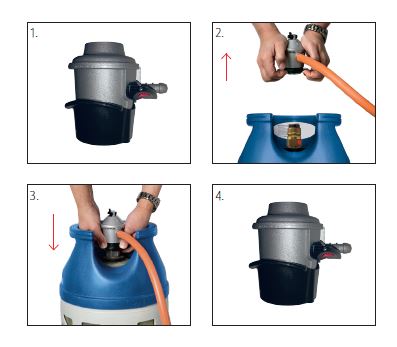 Composite balloon "Clip-on" connection system
Does your cylinder have a safety valve?
The old metal gas cylinders were not as safe as today's. For this reason, following EU recommendations, a new law has been adopted that regulates balloon exploitation.
As of January 1, 2020, it is no longer allowed to fill metal cylinders with gas that do not have a special safety valve - a valve. It is not necessary to change the pistons of the cylinder itself. If the cylinder meets all the requirements, simply unscrew the old valve and replace it with a new type, with a safety valve.
This valve is needed so that in the event of a fire emergency and the cylinder becomes overheated or over-pressurized, the accumulated gas is released through the valve, rather than the cylinder itself exploding and causing property damage. When grilling outdoors, such gas leakage simply dissipates into the air.
And if you want to learn more about gas cylinders, their selection, connecting them to the grill or are considering the choice of the barbecue itself, we invite you to come to us, to our renewed sales showroom in Kaunas, Galindu str. 9. We have a huge number of different grills in the exhibition, intended both for beginners and experienced amateurs, as well as for professionals.